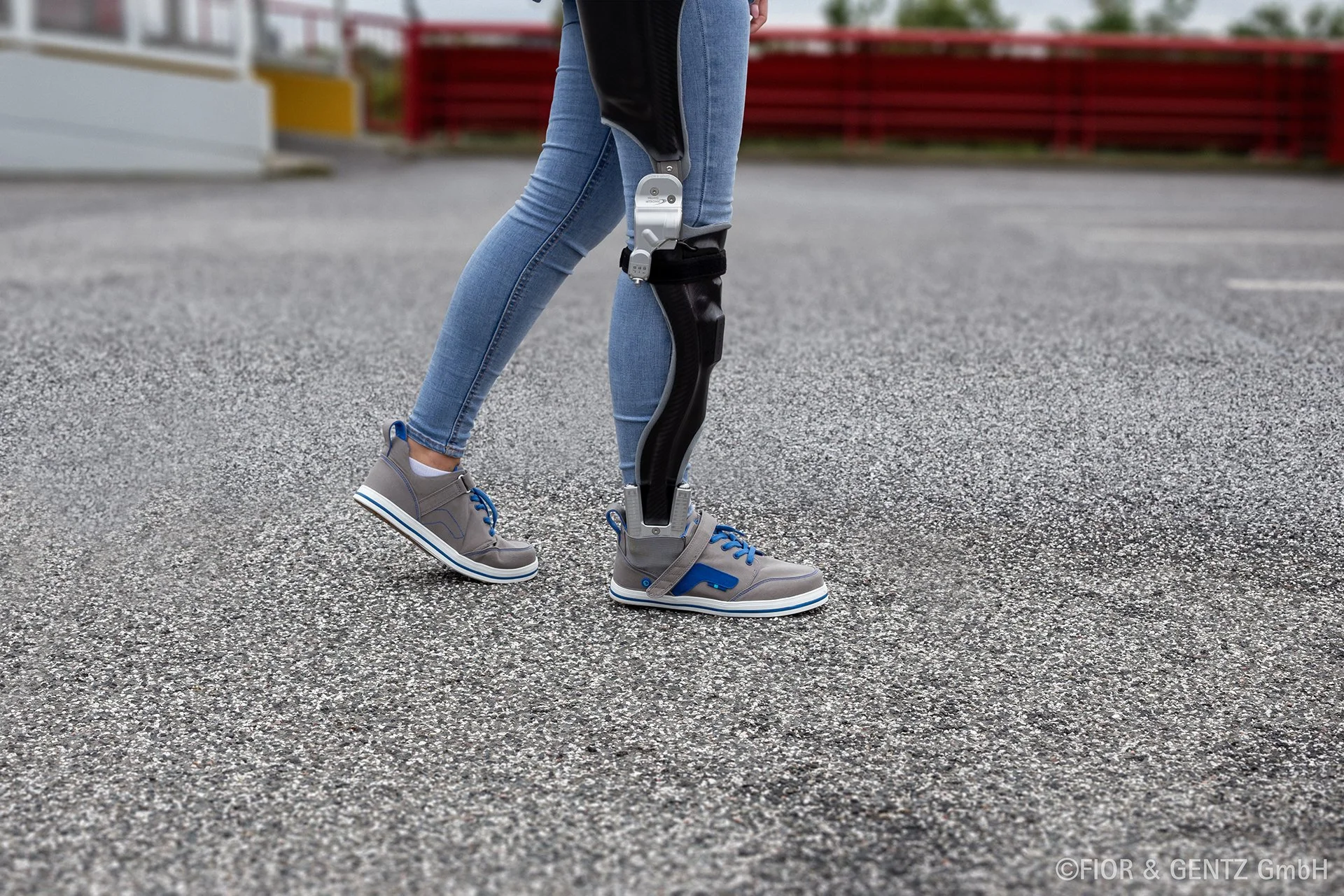
What is a KAFO?
What is a KAFO?
A Knee-Ankle-Foot Orthosis (KAFO) is a specialist medical device designed to support and stabilise the leg, helping people with muscle weakness, paralysis or joint instability to stand and walk more safely.
Unlike a prosthesis, which replaces a missing body part, a KAFO supports a person's existing leg. It typically extends from the upper thigh to the foot, providing support across the knee and ankle joints. KAFOs can be made using materials such as plastic, metal, leather and carbon fibre, depending on the individual's clinical needs.
KAFOs may be prescribed for people living with neurological or neuromuscular conditions, including polio, multiple sclerosis, muscular dystrophy and spinal cord injuries, as well as those affected by trauma or other conditions that cause significant lower-limb weakness.
The primary purpose is to compensate for weakness or instability that makes standing and walking difficult or unsafe. However, not all KAFOs function in the same way. Different designs offer varying levels of knee stability, freedom of movement and support during everyday activities.
Understanding how KAFOs work
Walking involves two main phases:
Stance phase: When the foot is in contact with the ground and the leg supports the body's weight. During this phase, the knee needs sufficient stability to prevent it from collapsing.
Swing phase: When the foot lifts off the ground and moves forward to take the next step. Normally, the knee bends during this movement, allowing the foot to clear the ground naturally.
The key difference between KAFO designs is how they control the knee during these two phases.
Traditional KAFOs generally prioritise stability by restricting knee movement. More advanced systems aim to provide stability while allowing the knee to bend when appropriate, helping users adopt a more natural walking pattern.
1. Locked Knee-Ankle-Foot Orthoses (Locked KAFOs)
Locked KAFOs are one of the most established forms of lower-limb orthotic support.
They are designed to keep the knee in a straightened position during both the stance and swing phases of walking. The knee joint is mechanically locked to prevent unwanted bending and provide stability for individuals whose muscles cannot adequately support their body weight.
The locking mechanism can normally be released manually when the person needs to sit down.
2. Free-Motion KAFOs
Free-motion KAFOs use knee joints that permit bending and straightening rather than remaining locked during walking.
The device may still provide structural support to the leg, help control knee alignment and stabilise the ankle and foot, but it does not necessarily prevent the knee from bending under body weight.
3. Posterior-Offset KAFOs
Posterior-offset KAFOs provide an alternative to permanently locked knee joints.
Their design positions the mechanical knee joint behind the normal knee-joint axis. This helps create a stabilising effect when the person's weight passes through the leg during standing and walking.
Unlike a locked KAFO, the knee can bend during the swing phase, allowing the lower leg to move forward more freely.
4. Stance-Control Orthoses (SCOs)
Stance-control orthoses represent an important development beyond conventional locked KAFOs.
Rather than keeping the knee locked throughout walking, these systems are designed to provide knee stability during the stance phase and allow knee flexion during the swing phase.
This means the knee can be secured when the leg is supporting body weight and released when the leg needs to move forward.
Stance-control devices can use different mechanisms to achieve this, including mechanically operated systems and electronically controlled joints.
Some mechanical systems rely on knee or ankle position to activate the locking mechanism. Electronically operated systems can use sensors to detect leg position and determine when the joint should lock or release.
For example, Ottobock's E-MAG Active is an electronically controlled stance-control knee joint that uses sensors to monitor the position of the leg during walking.
5. Microprocessor-Controlled Stance and Swing Orthoses
Microprocessor-controlled stance and swing orthoses are an advanced form of KAFO designed to provide more adaptable knee support throughout walking.
Unlike conventional stance-control devices, which primarily switch between locking and unlocking the knee, these systems use electronic sensors and a microprocessor to continuously adjust resistance to knee movement.
One example is Ottobock's C-Brace, a microprocessor-controlled stance and swing orthosis developed for people with significant knee instability caused by lower-limb muscle weakness or paralysis.